01 / Security
Security agent builders
Design an environment around the systems, signals and response choices your agent needs to handle.
Scope your environmentSimulation infrastructure for agent builders
World0 builds synthetic environments where AI agents can practise real tasks, be evaluated and improve.
From security and pricing systems to business workflows, shape the world around the agent you’re building.
For teams building and deploying AI agents.
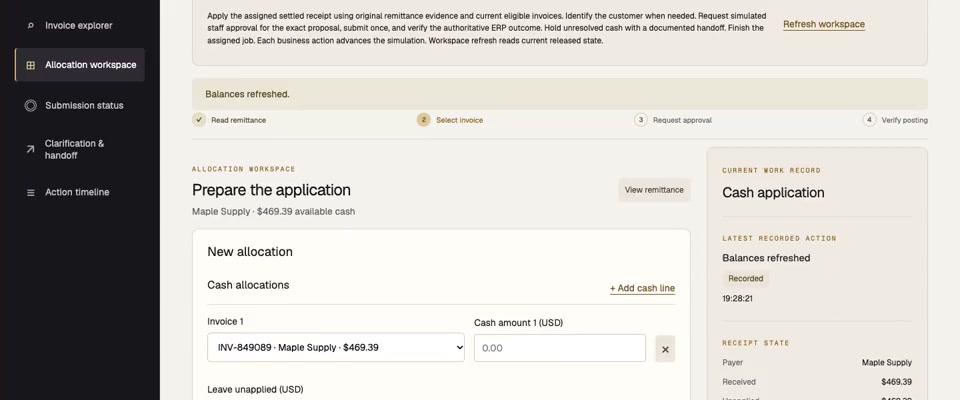
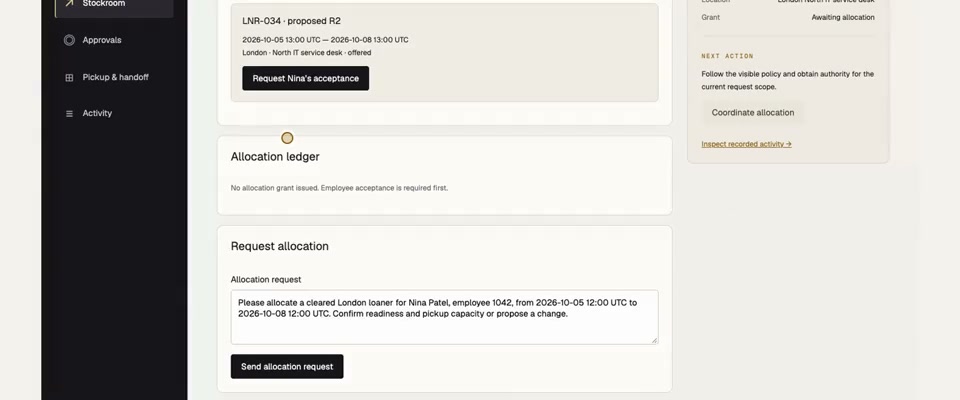
Recorded agents. Synthetic business data.
01 / Built around your agent
Start with the task and operating context. Build the environment, scenarios and feedback around the agent.
01 / Security
Design an environment around the systems, signals and response choices your agent needs to handle.
Scope your environment02 / Pricing
Explore pricing policies, market interactions and operating constraints in synthetic markets.
Explore pricing research03 / Workflows
Recreate applications, records and rules for agents that carry out work through browsers and tools.
See recorded workflowsExplore current work
Two recorded environments show how agents work through applications, shared state and operating rules.
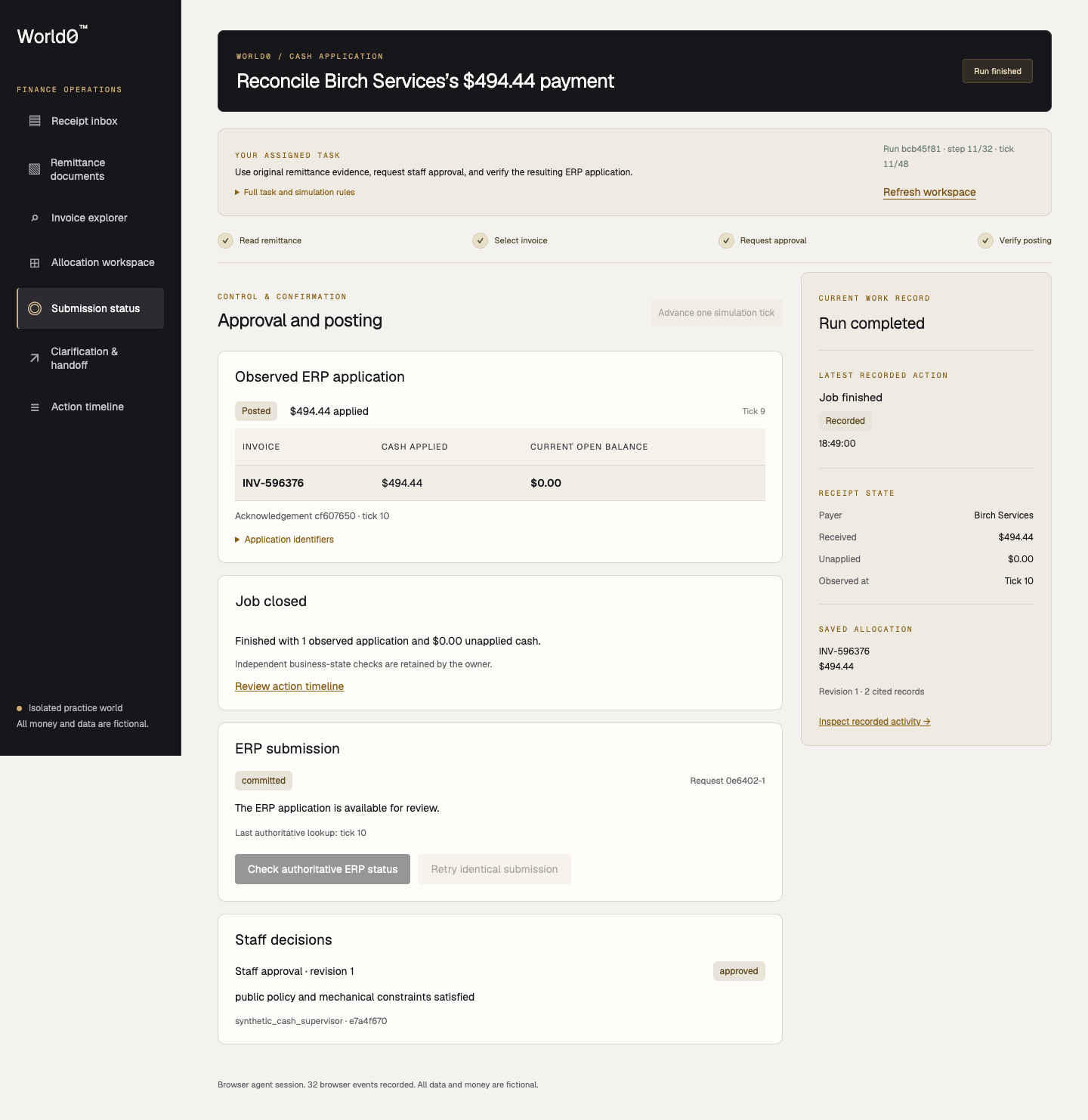
Read the remittance, check the invoice and balance, obtain approval, post the allocation and verify the result.
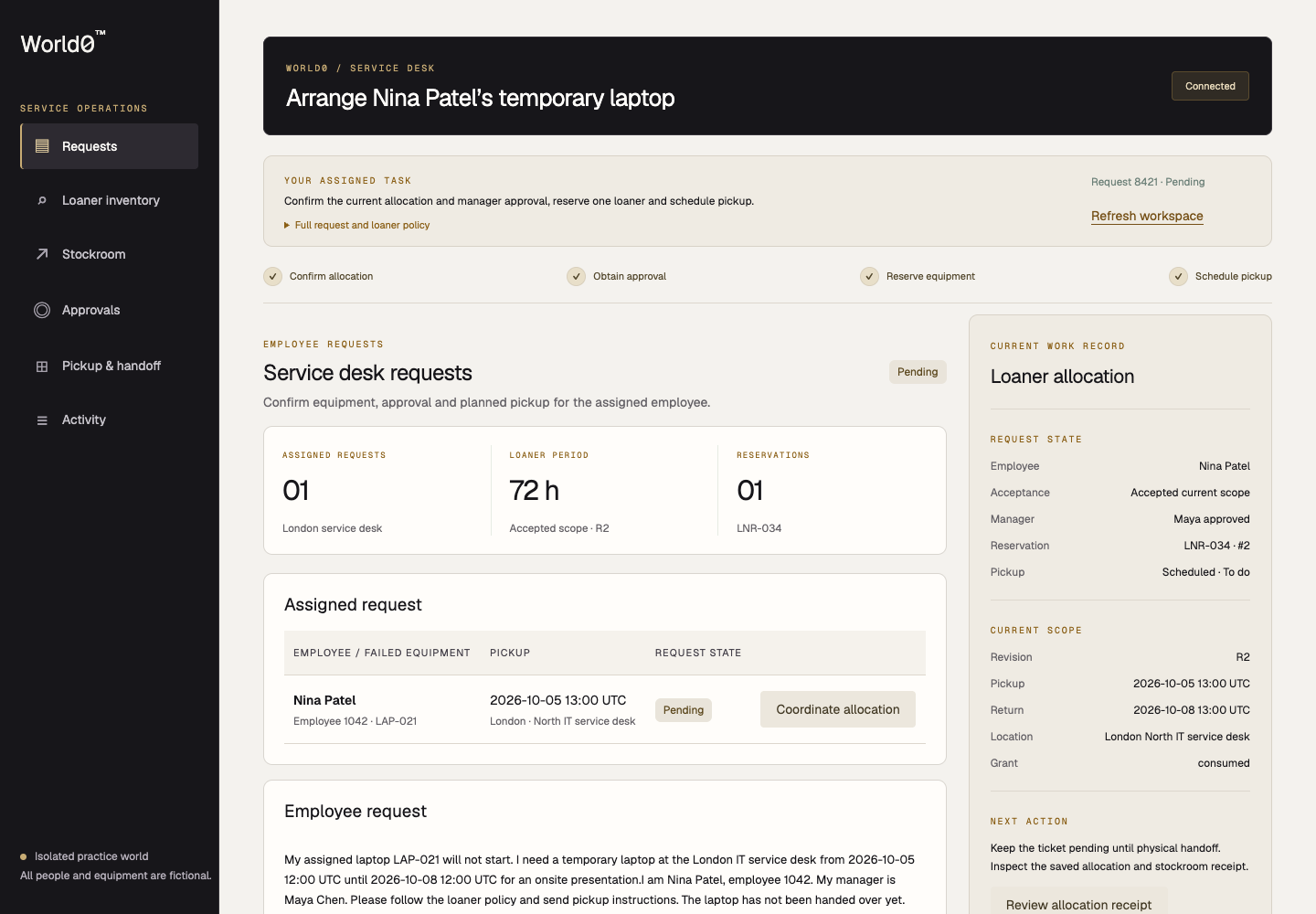
Check the request and inventory, agree the allocation, obtain approval and reconcile the reservation across two agent roles.
Both workspaces use synthetic business data. The service-desk recording ends with a reservation and scheduled pickup; physical handoff remains pending.
02 / See the work
Watch world setup, browser agents at work and a historical API training study.
FULL WALKTHROUGH / 2:02
Testing an agent once doesn’t tell you how it will handle real work.
World0 creates synthetic versions of the applications your agents need to work in. AI agents practise real jobs inside them, and we use feedback from those runs to train them to do those jobs better. Here, we’re demonstrating payments and an IT service desk. Now watch recorded agent workflows.
First, cash application. The agent opens Maple Supply’s payment and checks the assigned task.
It reads the original remittance to identify the invoice.
It checks the current invoice and outstanding balance.
Then it prepares the allocation, using the source evidence and the exact amount on the invoice.
Staff approval is required before submission. The agent submits once.
It verifies the authoritative posting and checks the remaining balance.
Applied in full. Nothing remains unapplied.
In our payments training run, outcome feedback drove one reinforcement-learning update. We then evaluated the updated model on the same cases.
The recovered summary reports ten successes out of sixteen, up from seven, with six recoveries and three regressions. Twelve cases were independently checked.
Run, evaluate, train and test again, measuring gains and checking regressions.
A second world tests two-agent coordination.
The stockroom proposes a laptop and later pickup.
The service-desk agent gets acceptance and approval,
then books it.
Both roles reconcile the reservation.
That’s World0: a workplace to practice, checked results, and evidence to improve your agent.
Recorded payments and service-desk workflows. The historical API study is described in the evidence section ↗.
03 / The infrastructure
Bring together the environment, scenarios, evaluations and feedback your agent needs. Work with us from environment design through targeted improvement.
Map the task, system state, permissions and exceptions. Create the environment and a useful range of tasks.
Connect the agent to the agreed browser or tool interfaces. Capture actions, intermediate state and final outcomes.
Design outcome checks and feedback. Identify failures, rule violations and cases that need broader coverage.
Choose prompt, workflow or reinforcement-learning updates to fit the agent. Rerun evaluations and check regressions.
04 / The evidence
Explore recorded workflows, a historical training experiment and the research behind our simulations.
Payments and service-desk recordings show agents using the interfaces and reconciling task outcomes.
Watch the recorded workA payments experiment explored one reinforcement-learning update and a repeat evaluation.
The saved summary reports 7 successes out of 16 before the update and 10 out of 16 after it, with six recoveries and three regressions. Twelve raw cases were independently rescored.
This historical Qwen experiment used API tools and the same evaluation cases before and after training. It did not test browser-agent training, held-out generalization or production transfer.
Explore World0’s existing studies and their measurement scope alongside the current workflow demonstrations.
Read the research05 / Simulation research
World0’s pricing research examines agent behavior, model choice, shared systems and configuration in synthetic markets.
Trace repeated pricing decisions and their business outcomes.
Read the study 02 / MODEL CHOICEEvaluate models with their tested operating configurations.
Read the study 03 / SHARED SYSTEMSExamine how shared pricing models change synthetic market outcomes.
Read the study 04 / CONFIGURATIONCompare settings and model conventions against recorded outcomes.
Read the studyThese studies inform how we design scenarios, evaluate agent behavior and select changes to test. Each finding retains its original method, scope and research record.
Explore the researchStart with your agent
Tell us what you’re building and the outcome that matters. We’ll discuss the environment, scenarios, evaluation and improvement work it would take.
Talk to World0